Love this cozy artistic bedroom coloring page? Share it with friends and family and enjoy creative fun together! ✨
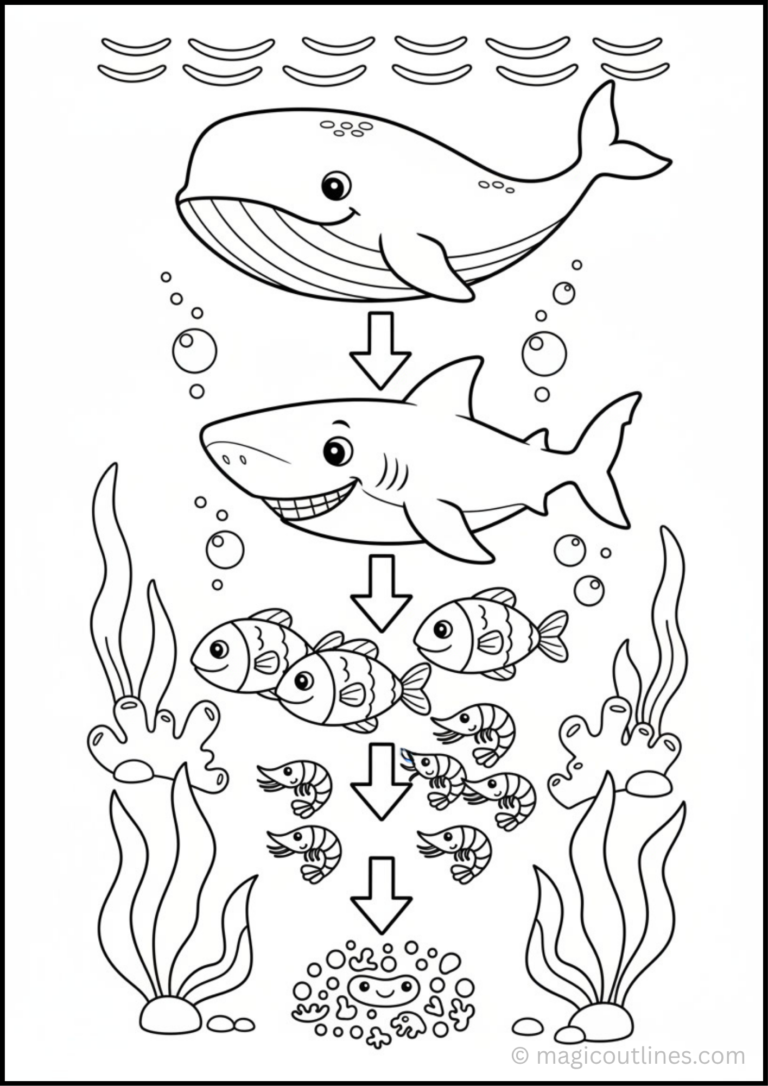
This Ocean Food Chain Coloring Page makes it easier for children to understand how ocean animals depend on one another while enjoying a creative activity.
This activity is a great addition to science lessons, marine-life units, homeschool activities, environmental studies, and classroom art projects. Coloring the different animals can make a potentially difficult science concept more approachable and memorable.
Children can also use the completed page as a visual learning aid. Parents and teachers can ask simple questions such as, “What does the arrow mean?” or “Which animal is higher in the food chain?” This encourages children to observe the picture and explain what they understand.
For more educational activities, explore our [Ocean Coloring Pages] collections.
Children can use the Ocean Food Chain Coloring Page to identify each level and learn about the connections between different marine organisms.
Below the whale is a large shark with a cheerful expression and visible teeth. The shark is connected to the next level by a large downward arrow. This makes the direction of the food relationship easy for children to recognize.
The next section features several small fish swimming together. Each fish has clearly outlined fins, tails, eyes, and body details. Children can give each fish a different color or create a matching school of fish.
Below the fish are several shrimp. Their curved bodies, legs, tails, and antennae provide interesting smaller areas for detailed coloring. Another arrow points toward the bottom of the illustration.
At the bottom is a group of tiny ocean organisms surrounded by small bubbles and simple sea-life shapes. These tiny organisms represent the lower level of the illustrated food chain and help children understand that very small organisms can play an important role in a much larger ecosystem.
Seaweed-like plants frame both sides of the picture, adding an underwater setting without making the illustration too complicated. Bubbles are scattered throughout the scene to create the feeling of being beneath the ocean surface.
Children enjoy learning about ocean animals because the underwater world is full of interesting creatures. Combining these animals with a simple science concept makes learning more interactive and enjoyable.
The illustration allows children to learn while they color. They can identify different animals, follow the arrows, compare large and small creatures, and begin to understand how living things are connected through food.
• Makes science learning more engaging
• Introduces basic food-chain concepts
• Encourages curiosity about marine life
• Supports fine motor skill development
• Improves concentration and observation
• Encourages color recognition and creativity
• Helps children remember visual information
• Provides a fun screen-free educational activity
1. What does the food chain show?
A food chain shows how living things are connected through feeding relationships and how energy moves from one organism to another.
2. What ocean animals are included in this activity?
The illustration includes a whale, shark, several fish, shrimp, and tiny ocean organisms surrounded by underwater plants and bubbles.
3. What age group is this printable suitable for?
This activity is suitable for children around 5 to 10 years old and can be adapted for younger or older learners.
4. Can this coloring page be used for a science lesson?
Yes. It can be used to introduce food chains, marine ecosystems, ocean animals, energy transfer, and environmental science.
Free Coloring Printable PDF
Discovering new coloring pages and creative ideas.
© 2026 Magicoutlines.com | All Rights Reserved