
Children naturally notice buildings around them. A tall tower, an old temple, a beautiful house, a bridge, or a large museum can all make them curious.
Architecture coloring pages give children a simple way to explore these ideas through art. Instead of only looking at pictures of buildings, children can study shapes, windows, roofs, doors, patterns, and surrounding landscapes while deciding how they want to color them.
At magicoutlines, architecture-themed coloring pages can also introduce children to different places, building styles, and cultural environments through printable artwork.
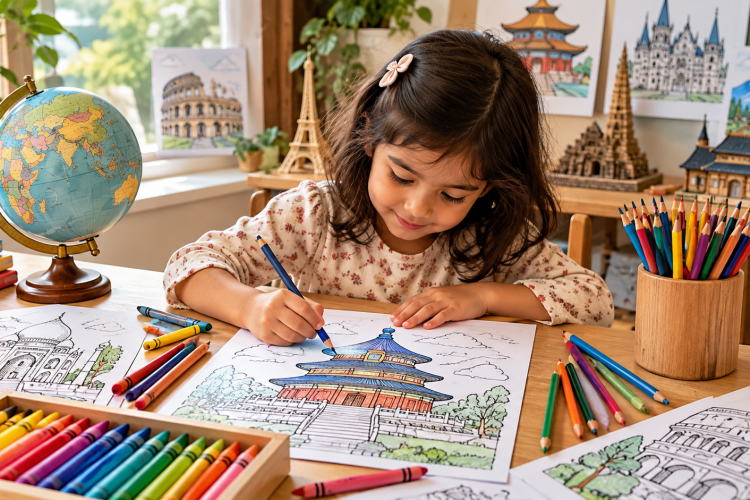
One of the easiest ways to introduce architecture to children is through shapes.
A building may have:
• Arched windows
• Round domes
• Tall towers
• Curved roofs
• Pillars
• Staircases
• Balconies
• Decorative patterns
While coloring, children begin to notice that buildings are not all designed in the same way.
For example, a traditional Korean Hanok has distinctive curved tiled roofs and a courtyard-style setting, while a Victorian mansion can have towers, balconies, decorative windows, and elaborate garden spaces.
This makes coloring a natural starting point for conversations about design.
Architecture can tell children a lot about a place.
A temple in Indonesia may look different from a traditional home in Korea. A historic building in Europe may have completely different shapes and decorations from a building in Asia.
For example, your Borobudur Temple Coloring Page introduces children to Buddhist architecture and the layered design of this famous Indonesian monument.
You can turn this into a simple activity:
Ask your child:
“Where do you think this building is?”
Then look at the coloring page together and talk about its design.
This turns a coloring session into a small geography and culture activity.
Detailed architecture pages contain many small elements.
Children may notice:
• Windows
• Doors
• Roof patterns
• Stairs
• Trees
• Gardens
• Walls
• Decorative details
Instead of quickly coloring the entire page, encourage children to look carefully at the picture first.
Ask:
“How many windows can you find?”
“What shape is the roof?”
“How many towers are there?”
“What do you see around the building?”
These simple questions can make coloring more interactive.
Landmarks are particularly interesting because they connect art with real places.
A coloring page can become the beginning of a small learning project.
For example, after coloring a temple, children can learn:
• Its name
• Where it is located
• What type of building it is
• What the surrounding landscape looks like
• Why the place is historically or culturally important
Your Temple of Heaven China Coloring Page, for example, features the famous circular layered roof and surrounding architectural details, giving children an opportunity to explore Chinese architecture through art.
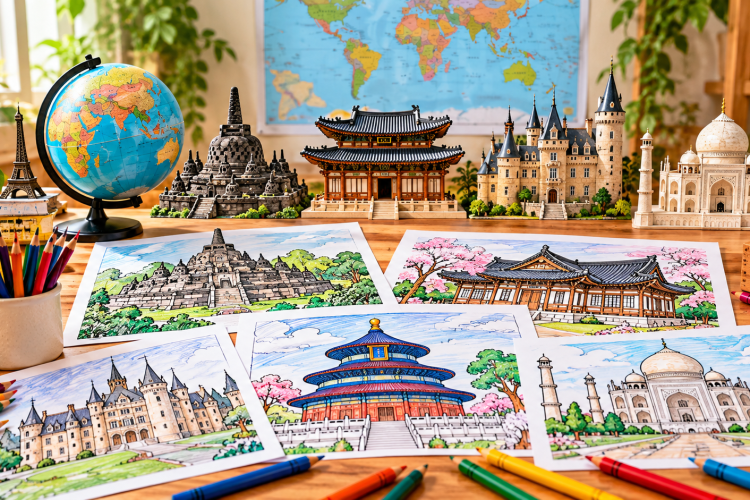
There is no requirement that a building must be colored exactly like a photograph.
This is where the creative side becomes exciting.
Tell children:
“You are the architect today.”
They can decide:
• What color the walls should be
• Which colors belong on the roof
• What the doors should look like
• What flowers should grow around the building
• What the sky should look like
They can even invent their own building after finishing the page.
For example:
“If you could build your own dream house, what would it look like?”
This can lead to a second activity where the child draws their own house beside the finished coloring page.
You don’t need complicated worksheets to introduce geography.
Choose one coloring page and find its location on a map.
For example:
Borobudur → Indonesia
Pashupatinath → Nepal
Temple of Heaven → China
Hanok → Korea
Your Pashupatinath coloring page already combines temple architecture with mountains, the Bagmati River, and Nepalese cultural elements.
After coloring, ask your child to locate the country on a world map.
This creates a simple art + geography activity.
Architecture doesn’t only mean famous monuments.
Children can also explore:
Houses, mansions, cottages, traditional homes and modern homes.
Temples, mosques, churches and other places of worship.
Libraries, hospitals, schools and community buildings.
Castles, old monuments and heritage buildings.
Homes and buildings that represent different cultures and regions.
This makes the subject much broader than simply coloring famous landmarks.
After printing an architecture coloring page, don’t immediately start coloring.
First, play a quick observation game.
Ask your child to find:
5 windows
3 trees
2 doors
1 staircase
Then let them start coloring.
You can change the challenge depending on the child’s age.
For younger children, ask them to identify simple shapes and colors.
For older children, ask them to identify architectural features and compare two different buildings.
This can become a fun ongoing project.
Choose one architecture coloring page from a different country each week.
For example:
Week 1: Korea
Week 2: Indonesia
Week 3: Nepal
Week 4: China
Children can color each page and write the country name underneath.
At the end of the month, they will have their own small World Architecture Art Collection.
You could even keep the pages in a folder or display them on a wall.
The best part of this activity is that you don’t need to turn it into a formal lesson.
Keep the conversation simple.
While your child is coloring, talk about:
• Where the building is located
• What shapes they can see
• What colors they chose
• What the building reminds them of
• What they would change about the design
• What kind of people might use the building
The goal is not to test the child.
The goal is to make them curious.
You can connect this blog naturally to your existing collection.
Korean Hanok House Coloring Page
https://magicoutlines.com/korean-hanok-house-coloring-page/
Borobudur Temple Coloring Page
https://magicoutlines.com/borobudur-temple-coloring-page/
Pashupatinath Temple Coloring Page
https://magicoutlines.com/pashupatinath-temple-coloring-page/
Temple of Heaven China Coloring Page
https://magicoutlines.com/temple-of-heaven-china-coloring-page/
Architecture Coloring Pages
https://magicoutlines.com/category/free-coloring-pages/architecture/
Your Architecture category already contains a broad collection of temples, historic landmarks and cultural buildings, so this blog can work as an informational entry point into that category.
Try this Color, Find & Learn activity.
Let the child choose a building they find interesting.
Allow them to choose their own colors.
Use a world map or globe.
Show the child a photograph of the building.
Ask:
“What looks the same?”
“What looks different?”
Ask the child to draw their own building inspired by what they saw.
This turns one printable page into several creative activities.
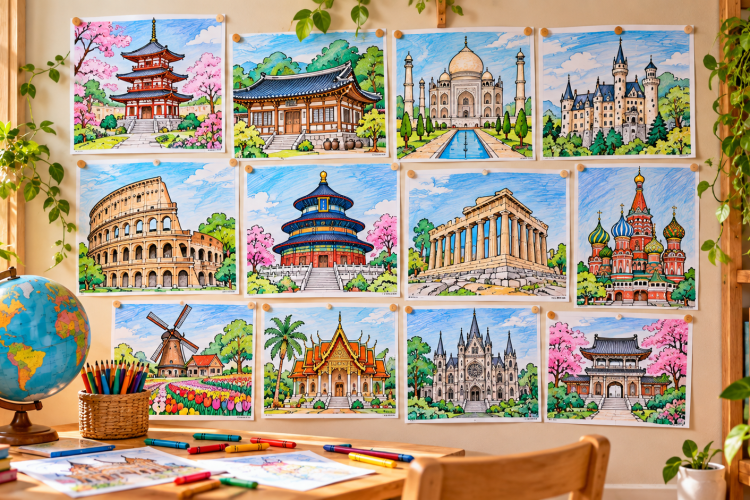
Architecture can introduce children to much more than buildings.
Through a simple coloring page, children can discover shapes, patterns, landmarks, geography, cultures, nature, and different ways people design the spaces around them.
They can color a temple, explore a traditional home, imagine a historic mansion, or create an entirely new building from their own imagination.
The most important part is to let children explore without worrying about making everything look “correct.”
Give them a coloring page, ask a few simple questions, and let their imagination take over.
At magicoutlines, you can explore free printable coloring pages across architecture, nature, flowers, vehicles, marine life, festivals, interiors and many other themes.
Explore more free coloring pages and start your next creative adventure
Children can also explore the UNESCO World Heritage Education Programme to learn more about world heritage and cultural sites around the world.

Free Printable Coloring Pages, Kids Stories, and Fun Learning Activities to spark creativity.
Discovering new coloring pages and creative ideas.
© 2026 Magicoutlines.com | All Rights Reserved